
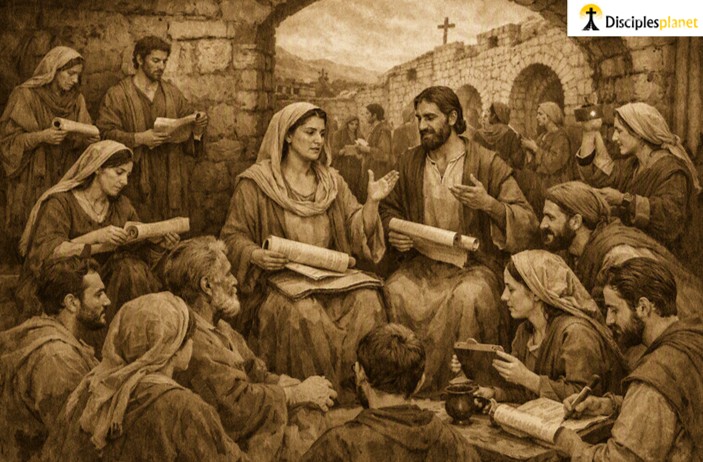
The Frame
For those familiar with the Diciplesplanet modus operandi on teaching, you will be aware that we always insist on looking at scripture through the three framing vehicles – lens, pivot point and bookends or if you prefer, content, context and canon.
All three are important to help us delve into the full Counsel of God and help us avoid the confirmational bias of ‘lens only proof texting’; you know the wielding a piece of Scripture to prove a point or attempt to hold a position. It’s a starting point, but in isolation it inevitably becomes problematic, especially when agendas of the ‘flesh’ are involved – i.e. pride, control, selfishness or worse.
Yet there is one more important piece to the interpretive puzzle that whilst extra-Biblical it still has important weight, especially in exegetical reckonings – that is culture.
The Word of God is all sufficient, authoritative and infallible in all it speaks to both at creation and today, but one cannot ignore the culture and context of the original audience of the era in which the writing was deployed.
We would argue that this is no more important than when we look at the subject matter of this particular article.
Paul the Misogynist or God Leveling the Sound ‘Ministry’ Field?
Reading 1 Timothy 2:11–15 in Its Canonical Context
First Timothy 2:11–15 is among the New Testament’s most debated texts. Read in isolation (our lens only frame up), it can appear to offer a universal and comprehensive prohibition on women’s ministry; read within Paul’s pastoral purpose, the Ephesian setting, and the wider apostolic witness, it addresses the church’s need for truthful teaching, ordered worship, and holy perseverance. The concern is not the exclusion of women from discipleship or service, but the preservation of the gospel from error and self-assertive authority.
Paul’s wider charge to Timothy is decisive: Timothy has been left in Ephesus to confront those who teach “different doctrine” and occupy themselves with speculative myths rather than “God’s work—which is by faith” (1 Timothy 1:3–4). Thus, the instructions of chapter 2 arise within a community threatened by doctrinal instability. The apostle’s aim throughout the letter is that all believers may know “how one ought to behave in the household of God,” the church being “a pillar and buttress of the truth” (1 Timothy 3:15). And as women are now fully included in this new Way (as the early church was known) this culturally new space for women was learning to be navigated in a previously culturally limited experience – Woman weren’t being limited, rather liberated.
Learning as Discipleship
Paul begins: “Let a woman learn quietly with all submissiveness” (1 Timothy 2:11). The first and often overlooked command is that women are to learn. In the ancient world, where formal theological instruction was frequently limited by social convention, this is a significant affirmation of women as genuine disciples—persons to be instructed in the apostolic faith and equipped for mature Christian life – a Life that Paul affirms in other writings, especially the letter to the Ephesian Church, that means all coming to the fullness of the stature of Christ (Ephesians 4:11-14). As such this is also about all followers of Christ fulfilling the most important Kingdom posting as Ambassadors of this Kingdom
The accompanying language of quietness and submission should be read alongside Paul’s concern for peaceable worship and orderly conduct. Earlier in the chapter he calls the whole church to pray for a “peaceful and quiet life, godly and dignified in every way” (1 Timothy 2:1–2). The term translated “quietly” need not imply absolute silence; rather, it evokes a settled, non-disruptive posture receptive to God’s truth. The same quality is expected broadly within the Christian community, not imposed uniquely as an expression of female inferiority.
Paul also hits this issue in his interactions with the fledging church in Corinth, where, again, women are being allowed into the church and are being exposed to learning, the same as men. The call for ‘silence’ indicated in this context is understood to be about order, not censorship or suppression. Some commentators have posited that woman would ask questions out loud and interrupt the teaching session and its important continuity process. Paul then gives a cultural and seasonally contextual commission (1 Corinthians 14:34-35) for woman to ask those questions at home and discuss them with more informed persons on these matters.
Authority, Teaching, and the Ephesian Crisis
Further into this article we are going to look at a strong Matriarchal undertow that heavily informed the region in which this fledgling Christian Church was planted and the very young male Pastor in charge of it. This was (as we’ll unfurl later on) culture where not only was a female deity worshipped, but where women were the dominant and arguably ruling class. New converts to Christianity from this culture would carry perspectives and postures that would need to be recalibrated, not for suppression, but for understanding Kingdom equality through humility and service. This new Kingdom is an upside-down and significantly different from the prevailing cultures into which it was sown.
Paul then writes, “I do not permit a woman to teach or to exercise authority over a man; rather, she is to remain quiet” (1 Timothy 2:12). This read alone as a lens appears to generate a simple and non-negotiable director. However, we also need to consider pivot points and bookends if we are going to really understand what is being communicated here.
For starters, whatever interpretive position one ultimately adopts—whether the restriction is understood as permanent for the office of elder or as a contextual prohibition prompted by the Ephesian situation—the text cannot responsibly be used to deny women’s full dignity in Christ, their obligation to learn, or (as mentioned earlier) their manifold participation in the church’s mission.
The disputed expression translated “exercise authority” (authentein) is rare in the New Testament, and its precise nuance is debated. It may carry a force stronger than ordinary, constructive leadership—such as seizing, dominating, or improperly wielding authority, which as hinted to before and will fully look at later, was the posture of the existing matriarchal culture. This kind of ‘authority’ is not the preferred posture of any leader in the Kingdom, female or male. At minimum, Paul refuses teaching or authority that destabilises the church’s fidelity to apostolic doctrine. Blending gnostic myths and esoteric eisegesis to the Counsel of God was a real and present danger that was constantly monitored and challenged by the early church fathers. The pastoral setting of false teaching in Ephesus (1 Timothy 1:3–7; 4:1–7; 6:3–5) remains essential to the interpretation process.
Creation, Fall, and Redemption
Paul grounds his reasoning in the creation and fall narratives: “For Adam was formed first, then Eve; and Adam was not deceived, but the woman was deceived and became a transgressor” (1 Timothy 2:13–14; cf. Genesis 2:18–23; 3:1–13). His appeal does not imply that women are uniquely or inherently gullible; Scripture elsewhere holds Adam accountable for humanity’s sin and presents sin as entering the world through “one man” (Romans 5:12–19). Rather, Paul invokes the Genesis narrative as a theological warning against the disordering of God’s word and the destructive consequences of deception.
The difficult statement that “she will be saved through childbearing” (1 Timothy 2:15) cannot mean that motherhood earns salvation. Paul consistently teaches that salvation is received by grace through faith, not achieved by human works (Ephesians 2:8–9; Titus 3:4–7). The verse instead directs attention to persevering Christian faithfulness: salvation is associated with continuing “in faith and love and holiness, with self-control” (1 Timothy 2:15). Whether “childbearing” is read as a reference to the birth of Christ, to women’s preservation through ordinary vocation, or to the restoration of faithful womanhood amid the fall, the text explicitly centres enduring faith and holiness rather than meritorious achievement.
Now if we add a cultural lens to these texts and what was happening at the time in that region and the perversions of Divine creative order by these Female deity worshipping gentiles and the culturally distorted Jewish women had to be addressed. The behavioural issues being carried into this new Kingdom by both heretical Jewish culture and dysfunctional Gentile practices that saw sex, the body and attending issues assault holiness and Kingdom propriety.
Equality in Christ and Diversity of Service
The broader Pauline ‘bookend’ writing prevents either a dismissive or reductionist reading of 1 Timothy 2. In Christ, ethnic status, social rank, and sex do not establish differing access to salvation or membership in God’s covenant family: “there is neither Jew nor Greek, there is neither slave nor free, there is no male and female, for you are all one in Christ Jesus” (Galatians 3:26–28). This is not a flattening of embodied distinction, but a declaration of equal standing before God, equal inheritance in Christ and equal call to Ambassadorship of a new Kingdom.
Romans 16 further displays women labouring visibly in the life and mission of the early church. Phoebe is commended as a diakonos of the church at Cenchreae and as a benefactor of many, including Paul (Romans 16:1–2). Prisca is named alongside Aquila as Paul’s co-worker in Christ Jesus (Romans 16:3–5), while Mary, Tryphaena, Tryphosa, Persis, and Julia are each recognised within Paul’s network of ministry and labour (Romans 16:6, 12, 15). These greetings make it impossible to portray Paul as withdrawing women from meaningful, public, and sacrificial service including, it would appear teaching and even other Ascension Gift mantles, as outlined in Ephesians 4.
The New Testament likewise records Philip’s four unmarried daughters as women who prophesied (Acts 21:8–9) and whilst one may argue that extrapolating that they were ‘Prophets’ is too long a bow to draw, it remains none-the-less authoritative in its directing and instructing ministry to the Body of Christ.
Taken together with the expectation that women pray and prophesy in the gathered community (1 Corinthians 11:5), this evidence indicates that 1 Timothy 2 should be interpreted with precision, not used as a comprehensive ban on women speaking, praying, prophesying, serving, teaching in every setting, or exercising every form of spiritual leadership.
Ecclesial Order as Gospel Witness
The theological centre of the passage is neither male privilege nor female marginalisation. It is the church’s vocation to embody the truth of the gospel through reverent worship, sound teaching, moral integrity, and mutual service. Christian freedom is not self-authorisation; it is freedom to be formed by Christ and to use every gift for the building up of his body (1 Corinthians 12:4–7; Ephesians 4:11–16).
Accordingly, contemporary churches should approach 1 Timothy 2:11–15 with interpretive humility. Complementarian readers may discern an enduring restriction relating to the authoritative teaching office of elders, while egalitarian readers may see a time-bound pastoral prohibition directed toward false teaching and disruptive authority in Ephesus. Both readings are obliged to affirm the text’s explicit call to women’s theological formation, the equal saving status of women and men in Christ, and the New Testament’s clear testimony to women’s substantial service in the apostolic mission (1 Timothy 2:11–15; Galatians 3:26–28; Romans 16:1–16).
Amazon Tradition, Artemis, and the Ephesian Church
The connection between Amazons, Artemis, and Ephesus belongs primarily to the city’s foundational memory—a powerful religious and civic tradition rather than securely recoverable social history. That memory nevertheless lends itself to explaining why Artemis was central to Ephesian identity and why the rise of the Christian church there produced both theological tension and public disturbance.
Amazonian Foundation Traditions
Classical writers linked Ephesus and its Artemis sanctuary with the Amazons, the legendary warrior women of Greek tradition. Pausanias records that the exceptional honour paid to Ephesian Artemis was associated both with the antiquity of her sanctuary and with the tradition that Amazons dedicated her image.
Other ancient traditions represented the Amazons as founders of either the city, the cult site, or both. A scholarly survey of the Ephesian foundation narratives notes that one stream depicts warrior Amazons as founders of Ephesus and its famous Artemis temple, while another attributes the city’s Greek foundation to Androclus during the Ionian migration.
This distinction matters: historians should not speak of a demonstrably historical “Amazonian culture” ruling Ephesus in the first century. Rather, Ephesians preserved and displayed an Amazon-linked civic mythology which associated their city with female martial strength, sanctuary, and the goddess’s ancient protection.
Artemis of Ephesus
The Ephesian Artemis should not be simplistically equated with the better-known Greek huntress Artemis. Her cult had deep Anatolian roots and was closely associated with fertility, protection, abundance, childbirth, civic welfare, and the productive forces of life.
The Artemision was not merely a religious structure but a centre of civic identity, pilgrimage, wealth, craftsmanship, and regional prestige. Amazon traditions reinforced this identity: the legendary women were remembered as devotees, founders, or protectees of Artemis, and Amazon statues were associated with the sanctuary’s artistic and cultic memory.
Thus, the city’s devotion to Artemis was not an incidental religious preference. Artemis embodied Ephesus’s claim to antiquity, divine favour, economic vitality, and cultural significance in Asia Minor – and all this promoting and sustaining a strong matriarchal culture and feminine dominance. Remember this is the place where a young male Pastor was now running a fledgling church, trying to lead a class of women who are used to being in charge.
Acts and the Artemis Riot
Acts 19 portrays Paul’s ministry in a city where conversion to Christ challenged an entrenched religious economy. Demetrius, a silversmith who produced shrines of Artemis, incited fellow artisans because Paul’s proclamation threatened both their trade and the goddess’s public magnificence (Acts 19:23–27).
The crowd’s cry— “Great is Artemis of the Ephesians!”—expressed more than private piety; it was a defence of Ephesian civic identity (Acts 19:28, 34). The city clerk identifies Ephesus as neokoros, commonly translated “temple-warden” or guardian of Artemis’s temple and sacred image (Acts 19:35), a title whose local relevance is widely recognised in scholarship.
Luke therefore presents the gospel as confronting idolatry not only at the level of personal belief, but also where worship sustains social honour, collective memory, and economic power. This is seismic and whilst necessary, not clearly appreciated by those whose existential anchor is being destroyed. The issue was not that Christians rejected women, fertility, or civic order; it was that they confessed the one living God and refused to grant Artemis divine status, as it did all other counterfeit contenders for divine dominance. (Acts 19:26; cf. 1 Thessalonians 1:9–10).
The Church’s Pastoral Context
Paul’s later correspondence to Timothy appears to address a church still ministering amid this religiously charged environment. Timothy was instructed to oppose alternative teaching in Ephesus and to cultivate a community marked by prayer, peace, godliness, sound doctrine, and ordered conduct (1 Timothy 1:3–7; 2:1–2; 3:14–15). Some Bible commentators explicitly situate 1 Timothy 2:11–15 alongside Romans 16:1–16 and Galatians 3:26–28, inviting the passage to be read within the wider Pauline witness to women’s discipleship, co-labour, and equal standing in Christ.
Whist this setting may illuminate—but cannot by itself settle—the debates surrounding 1 Timothy 2:11–15. The church was proclaiming that women, as well as men, must learn the apostolic faith (1 Timothy 2:11); that salvation rests in Christ rather than in deity, ritual, ancestry, fertility, or social status (Galatians 3:26–28); and that Christian women could be recognised as valued co-workers in the mission of the church (Romans 16:1–16).
The Epilogue
As earlier indicated the interpretive tool of culture whilst legitimate, is still subservient to context, content and cannon of Scripture. Thus, the Amazon-Artemis tradition provides a useful backdrop for understanding the cultural world surrounding the Ephesian church, but it must not become a speculative master-key for interpreting Paul. I want to note here too, that neither Acts nor 1 Timothy explicitly identifies a surviving Amazon movement as the source of false teaching, and the evidence more securely establishes Artemis’s pervasive civic and religious importance than a direct Amazonian programme within the Christian congregation.
The theological contrast is nonetheless clear. Artemis was celebrated as Ephesus’s guardian and glory; the Christian proclamation identified the church as “God’s household,” called to uphold the truth of the gospel (1 Timothy 3:15). Where Ephesian identity rested in a sacred image and its ancient cultic memory, the church’s identity rested in the crucified and risen Christ, whose saving grace creates one covenant people without regard to sex, ethnicity, or social rank (Galatians 3:26–28).
In this light, the Ephesian church was not called to erase women’s gifts or deny the social realities of embodied life. It was called to form women and men alike as faithful disciples, to resist deceptive teaching, and to embody a holy, ordered, Christ-centred alternative to the religious narratives that had long defined the city (1 Timothy 2:11–15; Romans 16:1–16).
This is the Kingdom – This is the culture and it was never meant to be about you or me, and our positional significance. Rather it is all about the only Hope for humanity, the Incarnated God, our Lord and Saviour, Jesus Christ. Our significance is in that relationship with our Heavenly Father and the restored communion with our Creator. If that is the focus and goal of your Discipleship journey, your service and impact will not only be ‘not in vain’ but have eternal weight and impact that the Saviour will one day declare the only validation we need…. ‘Well done good and faithful servant’.
Shane Varcoe – Disciplesplanet
Further Reading:
-
Equality GOD’S Way – The Surrendered Servant Club
- Emma Dryer: Visionary Bible Scholar & Kingdom Architect
Endnotes
-
https://throughtheword.org/
-
https://www.perseus.tufts.edu/hopper/text?doc=Perseus:text:1999.01.0160:book=4:chapter=31:section=8
-
https://ejournals.eu/en/journal/electrum/article/die-grundung-von-ephesos-im-spiegel-der-literarischen-uberlieferung
-
https://www.bsw.org/biblica/vol-90-2009/artemis-and-asiarchs-some-remarks-on-ephesian-local-colour-in-acts-19/23/
-
https://library.biblicalarchaeology.org/sidebar/the-riot-at-ephesus-acts-1923-41/
-
https://en.wikisource.org/wiki/1911_Encyclop%C3%A6dia_Britannica/Ephesus
-
https://www.bible.com/reading-plans/34893/day/248?segment=0